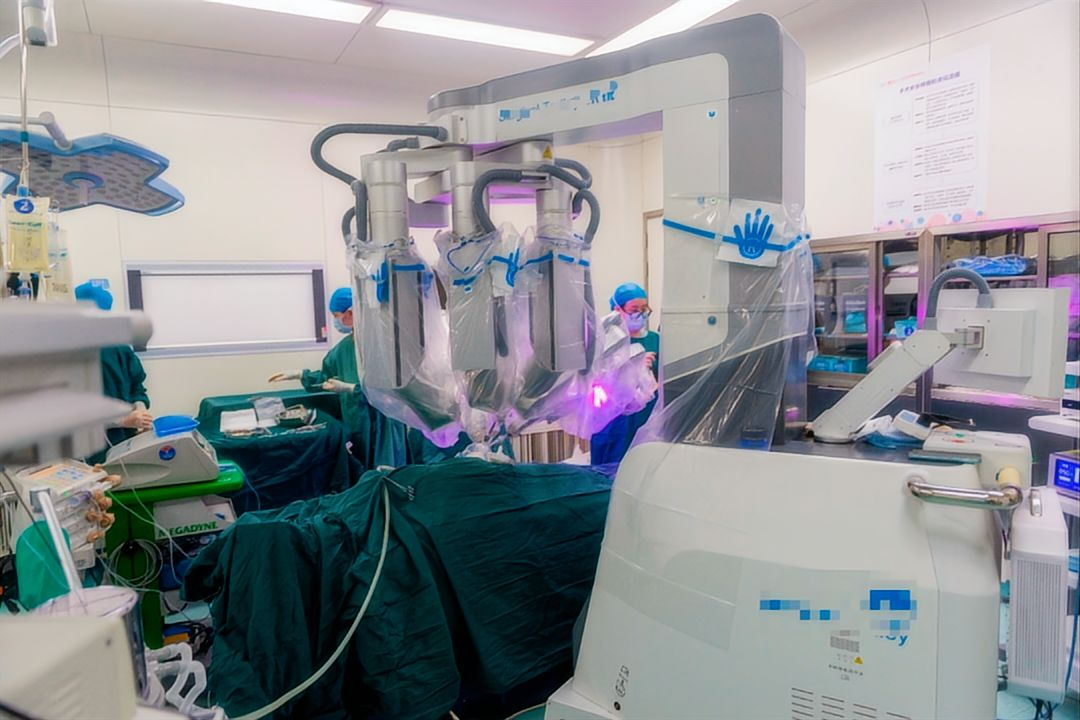
Recently, the Pediatric Surgery team at Guangzhou Women and Children's Medical Center Liuzhou Hospital successfully performed radical surgery and biliary reconstruction on a 1-month-old infant weighing only 3.3 kg with a choledochal cyst using a single-port surgical robot. This case represents the youngest and lowest-weight patient to undergo single-port robotic surgery at our hospital, and also the youngest case of single-port robotic surgery for pediatric choledochal cyst in South China.
The successful completion of this surgery not only demonstrates our hospital's technical capability in minimally invasive treatment of complex biliary tract diseases in extremely young children but also reflects our phased achievements in continuously improving the ability to treat severe and difficult pediatric conditions, leveraging a high-level platform.
For pediatric surgery, 1 month old and 3.3 kg are not just numbers. They signify a patient with even smaller anatomical structures, more delicate tissues, an extremely limited surgical space, and a need for even greater precision and stability in handling blood vessels and bile ducts.
Choledochal cyst is one of the common congenital biliary malformations in children. Without timely standardized treatment, affected children may subsequently develop biliary tract infections, jaundice, pancreatitis, liver function impairment, and other problems that can, in severe cases, affect long-term quality of life. Therefore, performing standardized radical surgery as early as possible is key to improving patient prognosis. However, for such a young, low-weight infant, the surgery itself is highly challenging: complete resection of the diseased bile duct must be combined with delicate biliary reconstruction; surgical safety must be ensured while minimizing trauma to create better conditions for the child's subsequent recovery and growth and development.
Precision Treatment in a Millimeter-Scale Space
During this surgery, the pediatric surgery team utilized the single-port surgical robotic system to perform precise dissection of the portal area and diseased bile duct under a high-definition, stable view, successfully completing the cyst resection and biliary reconstruction.
For young infants, the significance of the robotic system is not about "replacing the surgeon" but about helping the surgeon achieve more stable and precise manipulation in tighter, more complex spaces. Particularly in surgeries like choledochal cyst resection that involve delicate dissection and reconstruction, advancements in technological platforms offer new possibilities for pediatric minimally invasive surgery.
The lead surgeon wrote postoperatively:
"What does 3.3 kg mean? It's a weight that can be held in one palm. It's a challenge where blood vessels are as thin as hair and the operative space is measured in millimeters.
Yet it is precisely at this extreme limit that the advantages of robotic surgery are maximized – through a single-port approach, achieving precise dissection and reconstruction with minimal bleeding in a clear surgical field.
This is the youngest and lowest-weight patient to undergo single-port robotic surgery at our hospital.
I am grateful for the team's seamless collaboration. May this 'bloodless' surgery bring the child a future 'pain-free' life. Minimally invasive surgery is not merely a technical pursuit; it is the greatest gentleness towards a young life."
This passage precisely captures the core pursuit of pediatric surgery: to minimize trauma, accelerate recovery, and reduce the impact on a child's future growth as much as possible, while ensuring treatment efficacy.
Behind the Technological Breakthrough: Continuously Improving Regional Pediatric Medical Capacity
As a construction unit of the National Regional Medical Center, Guangzhou Women and Children's Medical Center Liuzhou Hospital has recently been continuously integrating high-level pediatric specialty resources, improving its capabilities in treating severe and difficult pediatric conditions, minimally invasive surgery, and birth defect-related diseases, while promoting high-quality maternal and child medical resources to radiate throughout the region.
The successful implementation of this extremely young patient's single-port robotic choledochal cyst radical surgery not only represents the completion of a single procedure but also reflects the hospital's development direction in building the National Regional Medical Center:
1. Continuously improving the standardized diagnosis and treatment capability for complex and difficult cases;
2. Continuously promoting the clinical translation of advanced minimally invasive technologies in the pediatric specialty field;
3. Enabling children in the region to access higher-level, more precise diagnostic and treatment services close to home.
The value is not only reflected in the ability to perform new techniques but also in whether these techniques can be truly translated into stable, replicable, and clinical capabilities that can benefit more children. This is the deeper meaning behind the success of such high-difficulty cases.
Protecting Long-Term Growth with Less Trauma
From traditional open surgery to minimally invasive surgery, and now to robot-assisted technology, the goal of pediatric surgery has never changed – to minimize surgical trauma to the child as much as possible while ensuring treatment efficacy, promoting faster recovery, and safeguarding better long-term quality of life.
Guangzhou Women and Children's Medical Center Liuzhou Hospital consistently adheres to being driven by the construction of high-level specialty capabilities, continuously improving the ability to diagnose and treat complex and difficult pediatric conditions, and promoting the translation and implementation of advanced minimally invasive technologies into clinical practice. The successful performance of this surgery is not only a manifestation of the hospital's continuously improving pediatric surgical technical level but also demonstrates our responsibility and commitment to serving children in the region, radiating care to surrounding areas, and driving the development of pediatric specialties.
In the future, leveraging the advantages of the National Regional Medical Center platform, our hospital will continue to promote the application of high-level diagnostic and treatment technologies to benefit more children, enabling more families to access high-quality, precise, and minimally invasive medical services right on their doorstep.

 Important Notes
The SHURUI Single-port Endoscopic Surgical System (SR-ENS-600), developed and produced by Beijing Surgerii Robotics Company Limited, has obtained the CE marking for urologic laparoscopic surgical procedures, gynecologic laparoscopic surgical procedures, general laparoscopic surgical procedures, and thoracoscopic surgical procedures. It is intended for use by trained surgeons in an operating room environment in accordance with the representative, specific procedures set forth in the User Manual.
Safety and Performance Information
Beijing Surgerii Robotics Co., Ltd. owns Surgerii®, SHURUI®, and other trademarks and may not be used without permission.