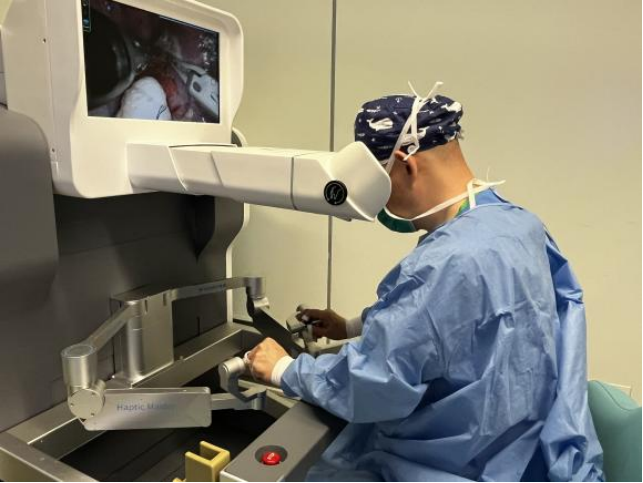
On March 18-19, the team led by Professor Li Zhigang from the Department of Thoracic Surgery at Shanghai Chest Hospital successfully completed two consecutive cases of China's first snake-arm single-port robot-assisted pure subcostal single-port right lower lobectomy for lung cancer. The procedure utilized the domestically produced Shurui snake-arm surgical robot. Throughout the entire operation, all maneuvers were performed exclusively through a single subcostal incision, with no auxiliary ports placed. Intraoperative blood loss did not exceed 30 ml in either case. The procedures were characterized by minimal bleeding and precise manipulation. Patients were able to ambulate on the day of surgery and experienced mild postoperative pain. This milestone marks the addition of a new "sharp tool" to the hospital's arsenal for minimally invasive treatment of thoracic tumors and vividly illustrates the clinical application of domestically produced high-end medical equipment.
Diagnosis and Surgical Approach: Precise Assessment, Confronting High-Risk Anatomical Challenges
Both patients were admitted following the detection of solid nodules in the right lower lobe during examinations, with a high suspicion of malignancy. Imaging studies and multidisciplinary team evaluations indicated indications for radical surgical resection. Due to the specific location of the lesions, situated adjacent to the heart and great vessels, traditional open surgery or conventional endoscopic procedures carried high risks and presented significant exposure difficulties. After meticulous preoperative planning, Professor Li Zhigang's team decided to employ the snake-arm single-port robot, selecting a subcostal approach for a pure single-port resection of the lung cancer lesions. This approach avoids the intercostal nerves, reducing postoperative pain, while providing a broader operative field for subsequent maneuvers, striving to maximally resect the lesion while maximizing preservation of chest wall integrity and respiratory function.
Surgical Implementation: Precise Single-Port Operation, Smooth and Efficient Throughout
Based on this precise preoperative assessment, the surgery proceeded as scheduled. In close collaboration with the anesthesiology and operating room teams, Professor Li Zhigang operated the Shurui snake-arm robotic system, operating confidently through a single subcostal incision. No auxiliary ports or additional punctures were used; all instruments and the endoscope entered and exited through the same portal. Under a 10x magnified field of view provided by the 3D high-definition endoscope, the team meticulously dissected the hilar and mediastinal structures with millimeter-level precision, carefully preserving blood vessels, bronchi, and surrounding tissues. The entire procedure was smooth, hemostasis was effective, blood loss was within 30 ml, and the radical resection of the right lower lobe lung cancer lesion along with systematic lymph node dissection was successfully completed.
Technical Difficulties: Dual Challenges Highlight Surgical Complexity
The smooth execution of the surgery relied on overcoming two core difficulties. First, the lesion was located in the right lower lobe region adjacent to the heart, vena cava, and hilar great vessels, creating an extremely narrow operative space. Any minor deviation could potentially cause major bleeding, demanding exceptional spatial judgment and hand-eye coordination from the surgeon. Second, the single-port technique means all instruments and the camera must enter the body through the same portal. Within this limited space, avoiding instrument "clashing" while maintaining operational dexterity and visual clarity poses an extreme challenge to the robot system's flexibility and the surgical team's seamless coordination.
Device Advantages: Snake-Arm Empowerment Makes Complex Minimally Invasive Surgery Possible
It is the unique design of the Shurui snake-arm single-port robot that surmounts these challenges. Its original snake-arm design possesses multiple degrees of freedom and submillimeter-level operational precision, allowing it to bend flexibly like a snake and form an operative triangle in the depth direction, perfectly meets the requirements of single-port minimally invasive surgery. The unique flat three-channel cannula layout effectively avoids instrument interference. Coupled with the natural advantages of the subcostal approach, which avoids intercostal nerve and muscle injury while providing a broader, more stable operative field, dissection and lymph node clearance in high-risk areas become safer and more thorough.
Expert Commentary: Practicing Minimally Invasive Concepts, Demonstrating Technical Prowess
"The single-port robot-assisted subcostal radical lung cancer resection is an important practice in our hospital's pursuit of ultra-minimally invasive surgery, rapid recovery, and functional preservation," stated Professor Li Zhigang.
"Compared to traditional multi-port thoracoscopy or open surgery, this technique offers distinct advantages, including a more concealed incision, less trauma, reduced postoperative pain, better chest wall stability, and faster recovery. It is particularly suitable for complex lung cancer cases with deep-seated lesions adjacent to major blood vessels. The successful completion of these pure single-port procedures—with no auxiliary ports and minimal blood loss—not only validates the reliability of domestic surgical robots but also demonstrates our department's mastery of complex minimally invasive techniques."

 Important Notes
The SHURUI Single-port Endoscopic Surgical System (SR-ENS-600), developed and produced by Beijing Surgerii Robotics Company Limited, has obtained the CE marking for urologic laparoscopic surgical procedures, gynecologic laparoscopic surgical procedures, general laparoscopic surgical procedures, and thoracoscopic surgical procedures. It is intended for use by trained surgeons in an operating room environment in accordance with the representative, specific procedures set forth in the User Manual.
Safety and Performance Information
Beijing Surgerii Robotics Co., Ltd. owns Surgerii®, SHURUI®, and other trademarks and may not be used without permission.