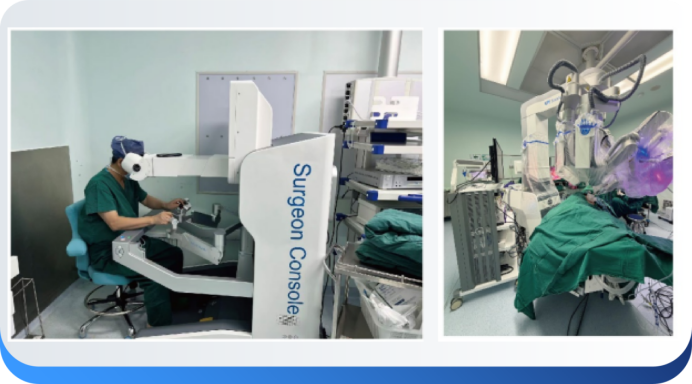
For a long time, urology has been one of the most mature and fiercely competitive fields for surgical robot applications. It encompasses a wide variety of surgical procedures, confronts complex and delicate anatomical structures, and demands exceptional precision, stability, and operational freedom from the surgical platform. The ability to perform reliably in high-difficulty urologic oncology surgeries is the key test of a surgical robot's true capability.
Recently, the Urology Department of Fujian Medical University Union Hospital provided a clear answer with a representative complex surgery. Professor Zhu Shaoxing's team successfully performed a radical left nephrectomy on a patient with stage T2b kidney cancer using the Shurui single-port surgical robot with snake-like instruments. The patient's renal tumor measured up to 12 cm in maximum diameter, representing the largest renal tumor ever removed by a surgical robot in China.
The significance of this surgery extends far beyond setting a new record. It clearly signals a shift: as the capability of single-port robots to perform complex surgeries gradually becomes routine, replacing multi-port approaches in an increasing number of scenarios, some traditional perceptions of single-port technology are continuously being challenged.
The patient's 12 cm tumor occupied most of the left abdominal cavity, compressing and displacing anatomical layers, twisting and crowding the renal pedicle vessels, limiting the surgical field, and constricting the operating space. In such a "crowded" environment, achieving complete tumor resection and precise division of the renal vessels while avoiding intraoperative tumor rupture or dissemination is an extremely challenging operation for any surgeon.
Traditionally, such surgeries often require multi-port laparoscopic or even open surgery, involving large incisions, significant trauma, and slow recovery. However, Professor Zhu Shaoxing, leveraging his extensive experience of over a thousand robotic surgeries, decided to take on the challenge—performing the radical resection using a single-port robot. The very fact that such a surgery could be completed via a single-port approach speaks volumes: there is no inherent "capability boundary" for single-port robots in complex urological surgeries; it depends more on the experience and skill of the surgical team than on the surgical approach itself.
The true value of single-port robotic surgery is not simply reducing the number of incisions, but elevating the level of minimally invasive surgery to new heights without compromising the radical nature of tumor resection or surgical safety.
In this surgery, the single-port surgical robot utilized snake-like instruments through a single 3-4 cm umbilical incision (the incision was appropriately extended for specimen retrieval). Supported by a high-definition, three-dimensional stereoscopic visual field, the surgeon could flexibly manipulate the instruments within the tight operating space, clearly identify tumor boundaries, precisely dissect vascular anatomy, and perform high-precision surgical maneuvers, resulting in significantly reduced intraoperative blood loss and minimized tissue trauma. Even for a giant 12 cm tumor, the single-port robotic surgery achieved the dual goals of radical tumor removal and extreme minimally invasive outcomes, providing the patient with a smaller incision, faster recovery, and lower pain scores.
The success of this surgery is inseparable from the technological support of the Shurui robot. As a domestically developed single-port surgical system, Shurui's core advantage lies in its unique snake-like instruments design.
Unlike the straight, rigid instruments of traditional multi-port robots, the snake-like possesses multiple degrees of freedom, enabling complex maneuvers such as "turning, encircling, and deep operation" within narrow spaces. In scenarios where a giant tumor occupies the abdominal cavity and severely limits the operative field, this biomimetic snake-like structure allows the surgeon to perform delicate dissections in critical areas and stably control important blood vessels. Facing the complex challenges of rich blood supply, unclear boundaries of the renal hilar vessels, and extremely limited operating space, the snake-arm technology becomes a stable and reliable tool in the hands of the lead surgeon.
This reflects a shift in surgical approaches: in complex surgeries, single-port robots are gradually replacing traditional multi-port paths and becoming an important direction for minimally invasive urological techniques.
The success of this surgery is not only an ultimate test of the surgeon's skill but also a comprehensive validation of the single-port surgical robot with snake-like instruments. When a single-port robot can confidently handle a 12 cm giant kidney cancer, it means the clinical feasibility of this technological pathway has been fully demonstrated. For urology, the replacement of multi-port by single-port approaches is no longer a distant future vision but an ongoing reality. In this minimally invasive evolution led by domestically produced equipment, the Shurui single-port surgical robot with snake-like instruments is vividly contributing to the "Healthy China" initiative.
Throughout the development of minimally invasive techniques, the Urology Department of Fujian Medical University Union Hospital has always been at the forefront. As a major regional urological diagnosis and treatment center, under the leadership of Professor Zhu Shaoxing, the department established a mature multi-port robotic surgery system early on and was among the first in the country to introduce a single-port surgical robot.
Currently, Fujian Union Hospital's Urology Department has achieved routine performance of single-port robotic surgeries, covering various urological procedures. These procedures include radical prostatectomy, partial nephrectomy, radical nephrectomy, renal cyst surgery, ureteral stricture repair, and ureterovesical reimplantation. In some cases, the surgical incision can be controlled to approximately 1.8 cm. Behind this seemingly small reduction in incision size lies the surgical team's continuously improving ability to perform delicate operations in narrow spaces, reflecting the ongoing evolution of the minimally invasive concept.
In this new technological phase, Professor Zhu Shaoxing's team consistently adheres to the "patient-centered" philosophy, continuously refining the technical approach to provide patients with more minimally invasive and precise treatment options.

 Important Notes
The SHURUI Single-port Endoscopic Surgical System (SR-ENS-600), developed and produced by Beijing Surgerii Robotics Company Limited, has obtained the CE marking for urologic laparoscopic surgical procedures, gynecologic laparoscopic surgical procedures, general laparoscopic surgical procedures, and thoracoscopic surgical procedures. It is intended for use by trained surgeons in an operating room environment in accordance with the representative, specific procedures set forth in the User Manual.
Safety and Performance Information
Beijing Surgerii Robotics Co., Ltd. owns Surgerii®, SHURUI®, and other trademarks and may not be used without permission.