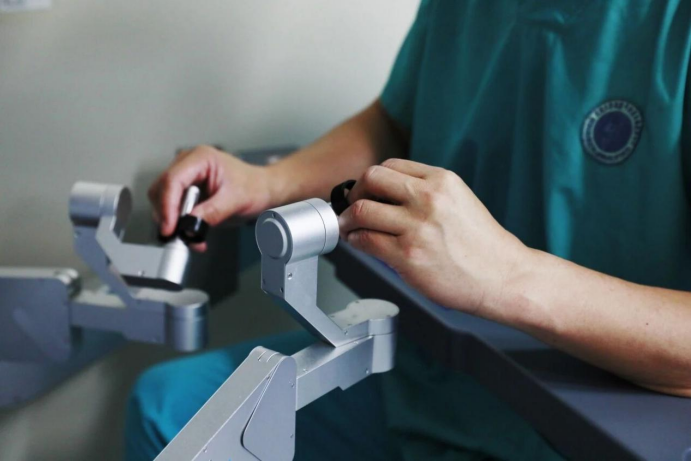
Inside the operating rooms of Peking University Shougang Hospital, a quiet surgical revolution is unfolding.
An incision of just 2.5 centimeters, the size of a coin, serves as the gateway into the depths of the human body. Through this tiny opening, three bionic snake-like instruments perform intricate procedures within the patient's abdominal cavity, successfully completing a pancreaticoduodenectomy — a procedure often regarded as the "Mount Everest" of abdominal surgery.
This remarkable technical achievement was made possible by the team led by Professor Leng Jianjun at the Hepatobiliary and Pancreatic Surgery Center of Peking University Shougang Hospital, utilizing the domestically developed Shurui single-port surgical robot. Having conquered this "summit of minimally invasive surgery," the team has now successfully mastered four highly complex procedures using this platform, marking the transition of what were once considered "surgical no-go zones" into the era of "ultra-minimally invasive surgery".
Technical Breakthroughs in the "Surgical No-Go Zone"
Pancreatic surgery is regarded as a high-risk, highly difficult field within hepatobiliary and pancreatic surgery. The reasons are clear: the pancreas is located deep within the abdominal cavity, surrounded by vital organs and a complex network of blood vessels, offering extremely limited surgical maneuverability — akin to navigating a highly critical anatomical zone where a minor misstep can lead to severe bleeding. Furthermore, pancreatic tissue is fragile, difficult to repair after injury, and carries a significantly increased risk of postoperative pancreatic fistula.
The challenge is particularly acute for pancreaticoduodenectomy. Due to its extreme difficulty, high technical demands, complex procedural steps, frequent intraoperative unpredictabilities, and numerous postoperative complications, this procedure is known as the "Mount Everest" of general surgery.
In recent years, the domestically developed Shurui single-port surgical robot has gradually entered clinical application, charting a new course for future development.
Its technological breakthroughs are evident in several aspects: the bionic manipulator arms, capable of multi-directional 135° bending, fundamentally solve the "chopstick effect" of traditional surgical instruments, greatly enhancing operational flexibility and precision. The arms, with a payload capacity exceeding 10N, ensure the stability and controllability of retraction maneuvers during surgery. The integrated 3D high-definition visualization system makes submillimeter-level anatomical details clearly discernible, providing reliable visual support for high-precision surgery.
For the surgeon, these technical advantages translate directly into a qualitative leap in surgical capability. Professor Leng Jianjun shares his impression: "In the past, when performing surgery on deep-seated tumors, we often felt constrained by the limitations of the instruments. Now, the robotics system gives us nearly 'needle-and-thread' fine control, allowing many previously difficult high-complexity maneuvers to be performed with composure and precision".
Since June 2025, Professor Leng Jianjun and his team have successfully completed 19 complex surgeries using the domestically produced single-port robotics system, including 5 liver resections, 8 pancreatic surgeries, and 4 biliary tract procedures, among others. Notably, the hepatobiliary and pancreatic surgeries represent the world's first single-port surgical robot with snake-like instruments procedures of their kind.
Leasing Model Accelerates Technology Adoption
If technological breakthroughs are the primary engine of this surgical revolution, then model innovation constitutes the secondary engine driving its implementation.
On December 24, 2025, the "Beijing Shurui Surgical Robotics Innovation Demonstration Center" was officially inaugurated at Peking University Shougang Hospital. At the ceremony, a groundbreaking signing simultaneously took place — through an innovative leasing cooperation model, Beijing's first single-port laparoscopic surgical robot was officially brought into the hospital.
This "robot + leasing" innovative model lowers the initial threshold for adopting advanced technology, enabling hospitals to deploy cutting-edge equipment more flexibly and efficiently, and rapidly enhance the diagnostic and therapeutic capabilities and technical level of relevant departments. One year into the pilot program, the hospital has completed over 30 surgeries using this device, spanning departments including general surgery, gynecology, and urology.
A 56-year-old patient, Mr. Zhang, diagnosed with distal bile duct cancer, successfully underwent a single-port robotic pancreaticoduodenectomy. Compared to traditional robotic surgery requiring at least five operating ports, this procedure was completed through just one 2.5 cm main incision and two accessory ports, resulting in less trauma and faster recovery. A surgeon involved in the operation commented: "Choosing the single-port surgical robot allows the patient to have a shorter, shallower postoperative scar, helps them get out of bed faster, and reduces pain".
Although Mr. Zhang experienced mild gastric emptying delay post-surgery, his diet gradually returned to normal after three weeks. More critically, the most feared complications of pancreatic surgery — pancreatic fistula and bile leakage — did not occur. Mr. Zhang's chemotherapy course is progressing steadily, and he is about to receive his final treatment. He reflected: "The pain was relatively mild, and I was able to get out of bed early. I could move around normally by the third day after surgery".
Symphony of Intelligence and Precision: A New Chapter
In another operating room at Peking University Shougang Hospital, a single-port laparoscopic robotic surgery is about to begin. The medical team is engaged in a detailed preoperative discussion of the case, while the surgical robot stands ready nearby, poised for this intricate "symphony" of cooperation.
From concrete practice to model refinement, the exploration at Peking University Shougang Hospital charts a clear path for healthcare innovation. It offers a replicable, exemplary reference for medical innovation nationwide: innovation must not only break boundaries within the laboratory but also enter the operating room, integrate into the healthcare system, and ultimately reach every patient in need.

 Important Notes
The SHURUI Single-port Endoscopic Surgical System (SR-ENS-600), developed and produced by Beijing Surgerii Robotics Company Limited, has obtained the CE marking for urologic laparoscopic surgical procedures, gynecologic laparoscopic surgical procedures, general laparoscopic surgical procedures, and thoracoscopic surgical procedures. It is intended for use by trained surgeons in an operating room environment in accordance with the representative, specific procedures set forth in the User Manual.
Safety and Performance Information
Beijing Surgerii Robotics Co., Ltd. owns Surgerii®, SHURUI®, and other trademarks and may not be used without permission.